






NBA’s ‘Script F’ Finals logo, 40 years after its debut, still means a team has made it big
This is a story about the NBA and the Logo.

Almost everyone who follows the NBA knows its iconic league logo – Dribbling Man, the silhouette of Hall of Famer Jerry West, though no one likes to admit that the late Los Angeles Lakers’ legend was the model.
This Logo is the one the NBA uses to announce that the league’s championship series has arrived.
The NBA Finals logo, with the Script F, and the shooting star over the “I” in Finals.
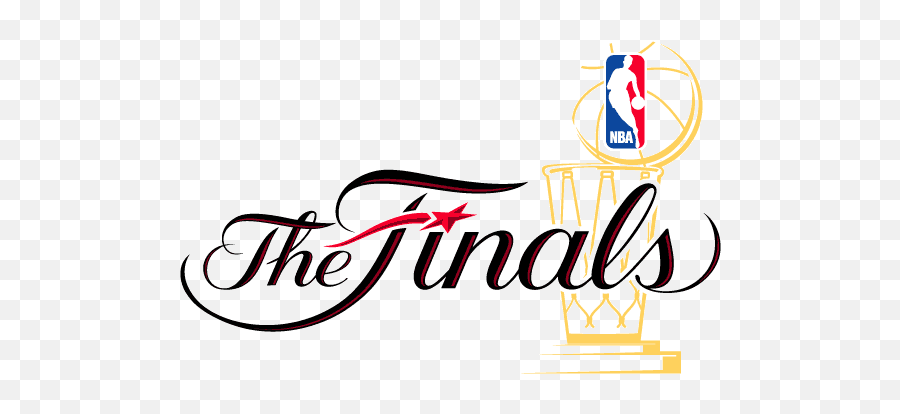
The NBA debuted the Script F in 1986, when the Boston Celtics met the Houston Rockets for the title. Forty years later, a slightly different version of the script logo will adorn the court at Frost Bank Center on Wednesday, when the San Antonio Spurs and the New York Knicks tip off the 2026 finals. The Script F has become as known for the championship series as the Larry O’Brien Trophy — which will return in logo form to center court Wednesday for the first time since 2009, and also be center court at Madison Square Garden when the series moves to New York for Games 3 and 4.
Rather than put a finals decal on the floor, which some players complained about as being slippery — or, good lord, superimposing one on the court for the TV audience, as the NBA did in recent years — the league will paint the Script F logo and the Larry into the wood at Frost Bank and MSG.
Like the Larry, the Script F logo means one thing: They’re playing for the ring. What other reason is there to do this every year? It means you’ve arrived as a team, or as a star player. You can put up all the numbers you want during the regular season, but if you don’t walk out onto a Script F/Larry court, you’re not in the rarest air — where the best of the best played.
“It means a lot, because for my career, I’ve only been able to see that finals logo on TV,” the Knicks’ six-time All-Star Karl-Anthony Towns said Wednesday. “So it means a lot to be the person that sees the logo on their jersey and has this opportunity. The word ‘grateful’ is all I can say.”
Back in the early 1980s, when the NBA was still trying to regain its footing after falling out of favor with large swaths of the American sporting public during the ’70s, the league didn’t have much on which to hang its hat. Magic Johnson and Larry Bird were just at the beginning of their pro careers. Michael Jordan, Hakeem Olajuwon and Patrick Ewing were in college. The NBA’s championship series was still being shown on tape delay — 11:30 p.m. ET, then-Johnny Carson time — to the East Coast of the United States.
And no one knew what to call the series.
CBS, which had the league’s broadcast rights in the early ’80s, called it the “NBA World Championship Series.” That didn’t exactly roll off the tongue like the Super Bowl, the World Series or the Stanley Cup. Even the NCAA had started using a catchy nickname for its championship weekend: the Final Four, in 1978. Each evocative. Each harkening back to memorable plays and moments. And, at any rate, the NBA’s version wasn’t the world championship series, as advocates of FIBA and other international governing bodies for the sport made clear to NBA leadership.
Desperate to create some buzz, someone at NBA HQ in Olympic Tower — mercifully, no one can now remember exactly who, though the late commissioner David Stern’s name came up — pushed the idea to call the 1982 series between the Lakers and the Philadelphia 76ers “Showdown ’82.” It had a logo and everything. And it made the NBA’s championship look like a cheesy, made-up event that would run on ESPN The Ocho. (“Coming up after the Great Eastern Skeet Shooting Championships … it’s Showdown ’82!”)

The Showdown ’82 logo. (Image courtesy of Brian McIntyre)
“Remember how small we were,” said Russ Granik, the NBA’s deputy commissioner at the time. “We didn’t have marketing people, creative people, and if Rick (Welts, the 2018 Naismith Hall of Fame inductee who is now CEO of the Dallas Mavericks) was there, he was selling sponsorships.
“I don’t know where it came from, except maybe David said something. We realized we had a real shortcoming in selling our championship series. People didn’t know what to call it.”
Showtime ’82 had a sequel — Showtime ’83, when the Lakers and Sixers met again in the championship series. It didn’t take, either.
“I actually think it was too closely aligned to the Showtime Lakers, and they were in those finals,” said Brian McIntyre, who was the league’s longtime senior vice president of communications.
Re-enter Granik. At the time, he lived in Westchester County and took the train to work. One of his neighbors worked in advertising.
“Russ and I were friends,” said Phil Brandon, the man who designed the Script F while in the midst of a decades-long career working with companies from Kenner Toys to Mitsubishi cars.
“Our careers kind of intermingled and intermixed, and we spoke about stuff. I was in the advertising world, and Russ was in his world. I like to joke about how I remember when I had a better car than he did. It was just purely, truly, a friendship thing.”
By 1985, after the Lakers and Celtics had played in back-to-back championship series, with Bird and Johnson rekindling the league’s greatest rivalry, the NBA was back on the upswing. It had begun to figure out its economics with its 1983 collective bargaining agreement with its players. At the same time, an incredible amount of Hall of Fame talent was coming into the league to join them, all between 1984 and 1989: Jordan, Olajuwon, Ewing, Clyde Drexler, Scottie Pippen, John Stockton, Karl Malone, Charles Barkley, Reggie Miller and David Robinson.
But the NBA was still searching for what to call the series in which the two best teams played at the end of the season.
“You need to have your ultimate event be identifiable, promotable, and therefore, ownable,” Brandon said. “Russ and I, on the train, would talk about stuff. Or when we were at the playground, pushing swings, we’d talk about stuff. And it just occurred to me as being a marketing problem like any other, really.
“I don’t mean to trivialize it, it’s just that it had the basic needs of a marketing problem — where, in effect, it was like a major new product introduction, at the same time that it was a brand extension … that created, for me, something that was a leap. I thought, they never are going to buy this, but they did. A mark that, literally, spelled it all out.”
Did Granik ask Brandon? Did Brandon volunteer his services to Granik? Neither really remembers.
“I must’ve just said, ‘I’ve got a friend. He does this for a living,’” Granik said. “I think he said ‘Give me a weekend.’
Basically, it happened that fast.
“The year, here — 1986,” Brandon said. “NBA — who is this? And, ‘Finals.’”

Then-NBA commissioner David Stern and CBS’ Brent Musburger stand in front of Phil Brandon’s logo, which debuted in 1986. (Dick Raphael / NBAE via Getty Images)
Who is it? What is it? When is it? It was that simple. Like Apple. Like 20th Century Fox. Something compact enough to fit on a hat or a T-shirt or, in what was important at the time, newspaper column spreadsheets.
“The grail for any advertiser is recall,” Brandon said.
And the Script F made it pop. Brandon likened it to what you’d see on a wedding invitation.
“At this point, in the life of this thing, you needed just absolute clarity,” he said. “Something that’s going to be totally dumb simple, but something that has some style, some emotion to it — in this case, two emotions: the strength and importance of the NBA Finals, expressed separately, differently, but together. How do you do that?
“That’s how this evolved to be what it is, what it was, initially. The only thing that was really a kind of a flourish, if you will, was the crossbar of the ‘F” of ‘Finals,’ and the shooting star.”
For 10 years, other than changing the year, the league used Brandon’s simple logo. The name took, becoming synonymous with Bird and Magic and Isiah Thomas and Michael each winning multiple titles, displaying the best the sport had to offer.
“It didn’t happen right away,” Granik said. “But people reacted positively to it. Back then, it was the (written) press that was really important in these things, and they seemed perfectly happy to use the logo as a visual. We said, ‘This seems to be doing pretty well.’ And over time, it’s not like somebody said this is good for marketing. Eventually, you want people to just say that’s what that is. We’re going to ‘The Finals.’”
And then, because someone always thinks they have a better idea, the league, starting in 1996, shelved the Script F in favor of a new one. No Script F. And, now, the O’Brien Trophy on the side. A version of that ran through 2002. In 2003, the O’Brien Trophy was replaced by the Dribbling Man/West logo.

The NBA replaced the Script F logo for the 1996 NBA Finals. (John W. McDonough / Sports Illustrated via Getty Images)
In 2004, returning to its senses, the NBA went back to Brandon’s Script F. They soon put both the Larry and Dribbling Man back into the design (Do people need to be reminded it’s the NBA Finals they’re watching? Do they think they’ve stumbled onto the Continental Basketball Association Finals?), but the Script F stayed. Until 2018, when YouTubeTV became the “presenting sponsor” of the finals. Out when Script F, back came Dribbling Man, for four years.
Finally — well, for now, anyway — the league brought the Script F back in 2022. At least, this time, the Script F is back in front of Larry and Dribbling Man, in what the league called at the time a “modernized” logo for the finals. And Brandon is pleased to see his creation back on center stage.
“At least ‘The Finals’ part found its way back (in 2022),” Brandon said. “I’m not the vengeful sort. Nor do I gloat.”